.svg)
O-rings are certainly the most widely used type of seal. They are not space consuming and their installation is very simple. If you follow the correct groove design and choose the right material, this sealing element will perform its function in the long term in both static and dynamic use. However, be careful to consider the temperature range and conditions that are suitable for the rubber material.
What is an O-ring?
An O-ring is a closed ring with a circular cross-section, which is mainly made of a flexible rubber material called elastomer. The size of the O-ring is defined by its inner diameter (Ød1) and cross-section (Ød2).
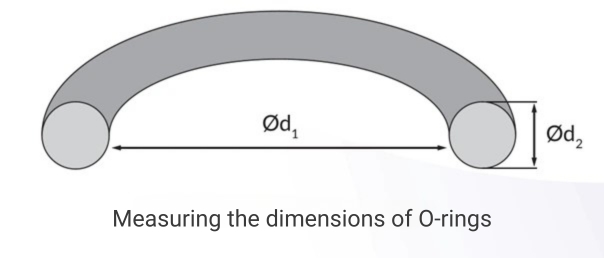
O-rings are most commonly made from various types of rubber by vulcanizing (cross-linking) the semi-finished product in moulds or injection moulds with a seamless surface.
How do O-rings work?
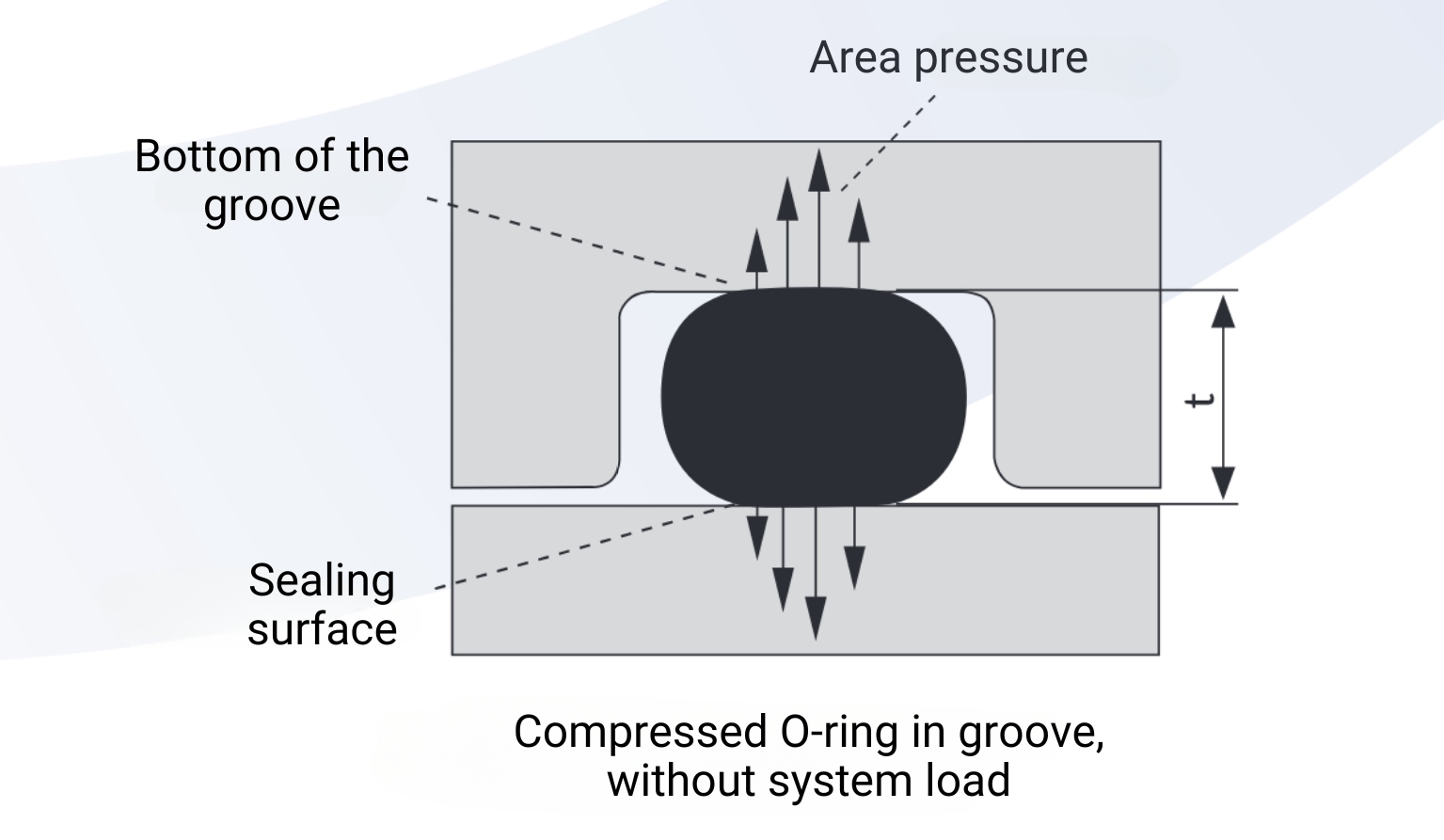
The sealing effect of the O-ring seated in a suitable groove is achieved during assembly by pressing to change the shape of the circular cross-section of the ring (d2) elastically into an elliptical profile. The compressed ring seals the gap between the contact elements or surfaces and the bottom of the groove.
 |
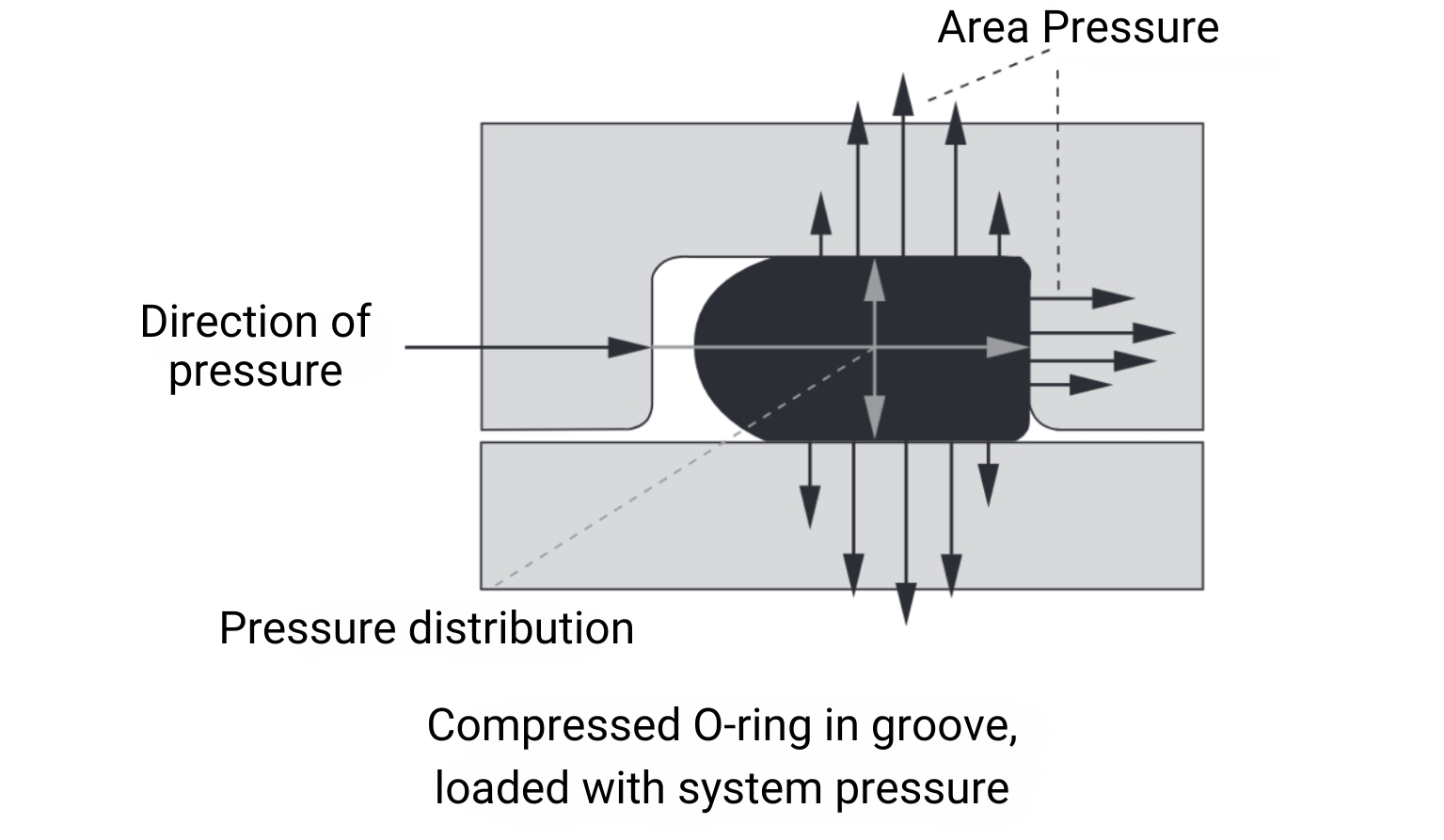 |
The sealing effect is thus the result of the change in the shape of the O-ring profile from circular to oval. The degree of this change depends on the depth of the groove (t). The clamping force thus generated is also referred to as the surge which ensures the tightness of the system. The cross-sectional diameter (cord cross-section) d2 must always be greater than the depth of the groove (t).
O-ring materials and their properties
Nitrile Butadiene Rubber (NBR)
NBR rubber is the most commonly used material for the manufacture of O-rings. O-rings made of this material are resistant to oils (especially hydraulic oils), as well as lubricants, gasoline and other aliphatic hydrocarbons, diluted acids and alkalis. They have excellent physical properties such as mechanical resistance, high frictional resistance and a good temperature range (-25 °C to +120 °C, up to -45 °C for special rubbers).
FKM O-rings are remarkable both for their high temperature range (- 20°C to + 200°C, special versions -40°C to +225°C) and for their chemical resistance to mineral oils, aliphatic and aromatic hydrocarbons as well as acids and alkalis. They also excel in mechanical properties and resistance to ageing.

Ethylene Propylene Diene Monomer Rubber (EPDM)
EPDM O-rings are mainly used for hot water and steam sealing, or where their excellent ozone and ageing resistance is used. Compared to NBR O-rings, they can also be used at lower temperatures (-40°C to +130°C, or -50°C to +140°C for special designs). They are not resistant to hydrocarbons. With peroxide treatment they are resistant to brake fluids.
Silicone Rubber (MVQ, VMQ, SI)
MVQ O-rings are mainly used in applications where a wide temperature range (- 5°C to +200°C) is required, but they cannot be used for hot water or steam sealing. Oil resistance is comparable to NBR, but mechanical properties are inferior to NBR.
CR O-rings have similar mechanical properties to NBR O-rings. They are slightly less resistant to oils, acids and alkalis, but their durability and ozone resistance is excellent. The temperature range of use corresponds with that of NBR O-rings (-30°C to +100°C, -40°C to +120°C for special versions).
Hydrogenated Nitrile Butadiene Rubber (HNBR)
HNBR O-rings are highly resistant to mineral oil additives, have very low water vapour and gas permeability as well as high ozone resistance. They also have excellent mechanical properties. They do not lose their mechanical properties even at low temperatures (temperature range -20°C to +150°C, up to -30°C for special designs).
Perfluoroelastomer (FFPM, FFKM)
FFPM O-rings combine the chemical and temperature resistance of PTFE while maintaining the mechanical properties of FPM. They are used in applications where standard FPM material is not sufficient or where maximum reliability is required. They are often used in pharmaceutical plants for their chemical properties combined with medical certification. Temperature range of use -15°C to +260°C, up to +325°C for special designs.
FMVQ O-rings add excellent resistance to oils, fuels, solvents to the properties of MVQ O-rings. This is especially true for aromatic and chlorinated hydrocarbons and alcohols. They are usable over a wide temperature range (-60°C to +200°C) even in the presence of aggressive mixtures of gasoline, alcohol, aromatic and naphthenic oils as well as chlorine-based solvents.
Aflas®, Viton-EXTREME-ETP® (FEPM)
These special rubbers belong to a new generation of fluoroelastomers. O-rings made of these materials exhibit a great many unique chemical resistances, being resistant to hot water, steam, ammonia, alkalis, bleaches, acidic vapors and oils, amines. They are resistant to media containing corrosive elements, long life engine oils, gear oils, brake fluids and aggressive oxidizing media. Temperature range -10°C to 200°C.
O-rings made of this material have a wide chemical resistance range, they are resistant to everything except liquid alkali metals or fluorine under pressure. Even the temperature range is excellent (-200°C to +260°C). However, all this is compensated by the inelasticity of this material, its use is limited to dismantlable constructions. Its reuse is not possible.
FPM or MVQ O-rings coated with Teflon (FEPFPM or FEPMVQ)
FEP O-rings are O-rings made of standard FPM or MVQ materials coated with PTFE. Compared to PTFE O-rings, they lose some chemical and temperature resistance but gain elasticity.
O-rings made of polyurethane material have very good mechanical properties, whether it is compression and tensile strength, high abrasion resistance or low permeability. The resistance to petrol and most technical oils, together with these mechanical properties, predestines these O-rings for use in moving bearings. The temperature range of use is from -30°C to 100°C, with special designs up to +125°C.
Natural rubber (NR)
Natural rubber O-rings are very elastic and have very good mechanical properties. Despite the very many different synthetic rubbers, natural rubber O-rings are often used in applications where high elasticity is required. Temperature range from -45°C to 100°C.
Acrylic rubber (ACM)
ACM O-rings are highly resistant to hot oils and are used for sealing automotive engine oils, gear oils, and other high temperature lubrication. They also have high resistance to ozone. Temperature range from -20°C to +175°C.
Ethylene Propylene Rubber (EPM)
EPM O-rings are excellent for sealing hot water and steam due to the peroxide crosslinking of the rubber. They are unique in their resistance to the atmosphere, being UV, ozone and rain (and acid) water resistant. They are not resistant to hydrocarbons including gasoline or mineral oils. Temperature range from - 0°C to +150°C, up to +180°C for special designs.
Chlorosulphonated Polyethylene (CSM)
O-rings made of CSM material are excellent against ozone, acids and alkalis, have excellent mechanical properties and a very long service life. They are not suitable for mineral oils, which cause them to expand. Temperature range from -25°C to 135°C.
Most common types of rubbers and their trade names
| Rubber | Abbreviation | Trade Name |
| Nitrile Butadiene Rubber | NBR | Perbunan®, Europrene N®, Krynac® |
| Styrene-Butadiene Rubber | SBR | Europrene®, Buna-S® |
| Hydrogenated Nitrile Butadiene Rubber | HNBR | Therban®, Zetpol® |
| Chloroprene Rubber | CR | Baypren®, Neoprene® |
| Acrylic Rubber | ACM | Nipol AR®, Hytemp®, Cyanacryl®, Viton® Extreme, Aflas® |
| Ethylene Acrylic Rubber | AEM | Vamac® |
| Fluorine Rubber | FKM, FEPM | Viton®, Dai El®, Tecnoflon® |
| Perfluoroelastomer Rubber | FFKM | Kalrez®, Perlast®, Chemaz® |
| Silicone Rubber | VMQ | Elastosil®, Silopren® |
| Fluorosilicone Rubber | FVMQ | Silastic® |
| Polyurethane Rubber | AU/EU | Urepan®, Adiprene® |
| Ethylene Propylene Diene Monomer Rubber | EPM, EPDM | Buna EP®, Dutral®, Nordel® |
| Isobutylene Isoprene Rubber | IIR | Esso Butyl®, Polysar Butyl® |
| Epichlorohydrin Rubber | ECO | Hydrin® |
| Natural Rubber | NR | Smoked Sheet®, Pale Crepe® |
| Polyisoprene Rubber | IR | Natsyn® |
Not sure how to choose the right seal? Do you need specialised parts?
In our e-shop you can choose from a wide range of seals and industrial parts. However, if you are unable to find a specific seal or require specialised parts, please contact us and we will try to resolve your enquiry.
